
August is here and not an article posted to The Prairie Urbanist. While I undertake and refine a few more labored, heady articles for my ever-growing and demanding audience, I wanted to share the happenings in Iowa City that I am following this year.
Unfortunately, in the last year I did not learn brevity or improve my coherence. Please make use of this table of contents:
Planning & Policy
- Iowa City’s Comprehensive Plan Update
- Form Based Code Amendments
Developments
- 21 S Linn St Redevelopment
- Coralville’s Gather Iowa Project
Transportation
- CRANDIC Dead. What now?
PLANNING & POLICY
Iowa City’s Comprehensive Plan Update
Iowa City, aided by the Des Moines-based consulting firm Confluence, began the multi-year process for updating its comprehensive plan this year. The city’s current comprehensive plan was adopted in 2013. Though many aspects of such plans are simply aspirational and not direct policy prescriptions, their importance is found in that any changes to zoning or land use policy are generally required to maintain congruence with the plans.
The initial public outreach process began in March, concluding last month in July, though input opportunities remain available on the project website. A draft of the new plan is expected to be available for public comment by the end of this year, or early next year, with the goal of full adoption by city council in May of 2026.
I attended a “Public Visioning Workshop” event in early June at the Iowa City Public Library. Attendance was disappointing, as the event numbered less than a dozen community members— though a Johnson County supervisor was present. The public input sessions seemed poorly promoted. I only found the event through knowledge of the project website and the city’s emailed news alerts. I could not find any discussion of the sessions or plan update within local news reporting, social media alerts, nor on r/IowaCity. This lack of awareness for the workshops is a missed opportunity, given that Iowa City normally enjoys a civically active population.
Why update the plan now?
Recent years have seen an increasing use of land use amendments to the comprehensive plan (and its subsidiary district plans) to facilitate development goals, from major student housing projects to the upcoming redevelopment of ACT’s former headquarters. The uptick in these amendments reflects that economic and development conditions are no longer reflected in the future land use map of the current plan. This is particularly evident in the case of the ACT property as diminished demand for suburban-style office parks endures post-pandemic.

The plan update was further anticipated by the city’s 2023 zoning code update, prior form-based code efforts, and city planning staff’s desire to reevaluate the 1997 and 2013 plan’s district subplan model. As previously covered on The Prairie Urbanist, Iowa City updated its zoning code in 2023 to allow duplexes and ADUs in single-family zones among other changes. In an August 2023 memo to the Planning and Zoning Commission (P&Z), city staff remarked that more substantial reforms to zoning were considered, but shelved due to concerns regarding congruency with the comprehensive and district plans. Most residential areas are capped at a density of 8 dwelling units per acre under the 2013 plan. Desire to alter the district plan model was echoed by The Daily Iowan’s reporting on the initiation of the plan update process in January 2024. (Unfortunately, this article is the most recent discussion of the plan update in local media.)
“At the council and commission meetings, city staff said these plans [district plans] are hard to maintain, so some are outdated and do not reflect the area’s current development needs. Also, some districts do not have their own plans, while other districts are so similar that their plans are essentially the same.” – Isabelle Foland, The Daily Iowan, (01/25/24).
It is not yet clear what city staff intends between reducing the number of district plans or eliminating them entirely. Some district plans are more consequential, as the ambitious Downtown Riverfront Crossings Master Plan includes detailed market analysis, urban design standards, and a specialized form-based code, while likewise the South District Plan and the Southwest District Plan hosted the city’s implementation of its more general form-based code. Eliminating these plans seems unlikely, as the form-base code standards and their future land-use maps were fully adopted into the city’s Title 14 – Zoning Code.

Given the regulatory recommendations made within the 2022 Affordable Housing Action Plan and the aforementioned comments by city planning staff, further zoning reform enabled by the land use portion of the comprehensive plan update appears likely. Potential reforms could include allowing multifamily housing in additional zones at densities currently impermissible under the 2013 Comprehensive Plan and further expansion of the form-based code beyond the current greenfield sites in the South and Southwest Districts (page 33 of the 2022 Affordable Housing Action Plan). The tendency of municipalities towards zoning deregulation continues to intensify nationwide, as indicated by UC Berkeley’s Zoning Reform Tracker.
In the last year since I posted an analysis of Iowa City’s 2023 zoning reforms, my own thinking on zoning reform has evovled—especially in regard to housing affordability. I still believe further zoning reform to encourage compact, varied, and dense urban forms seeking to reduce auto-dependency and promote urban resiliency is necessary and vital. However, I believe we need to abandon pop-urbanism’s tendency for conceptualizing the housing affordability crisis within libertarian economic understandings of supply and demand that is solvable by privatized actors. This focus on zoning and deregulation ignores and emboldens deeper issues of urban economics: the financial commodification of housing, gentrification and displacement, continued austerity for public services, inadequate wages for laborers, and the increasing capture of public wealth by private interests.
Not to be misunderstood— the current zoning regime in the United States produces poor urban forms and must be reformed; yet, zoning deregulation and empowering further corporate investment in urban development will not provide a permanent solution to housing affordability. I am eager to see the upcoming draft of the plan update and hope that the land use portion will reflect this nuance.
Follow the project website for more news and updates. It may be the only place you hear about it!
Form-Based Code Amendments
In May, Iowa City City Council unanimously passed an ordinance minorly amending the city’s general form-based code adopted in 2021 for greenfield development in the South District. The amendments included minor modifications to several building dimensional requirements, glazing standards, driveways, and more flexibility in making updates to neighborhood plans, in addition to new exemptions of block sizing standards. The full text of the amendments is available within the March 5th Planning & Zoning Commission agenda.
The amendments themselves are mostly benign and administrative, but notable as the changes evolved out of meetings with a developer, Navigate Homes, who is working to begin the city’s first project under the form-based code. Though no shovels are in the ground, the promptness of the council’s passage (waiving 2nd consideration) may be a signal that construction is likely not far away. City staff also released a condensed guide to the code, in an attempt to encourage more interest in its use.

A full analysis and examination of the form-based code is beyond the scope of this article. Yet, my initial criticisms are in brief:
- the code fails to fully abandon the traditional Euclidean zoning paradigm
- the dimensional standards of street right-of-way and building spacing will temper neighborhood walkability and housing density
- the code remains oriented around developers proposing a neighborhood plan, subdividing, and building at scale– rather than the incremental process that produced the traditional built-form the code is inspired to recreate.
In pursuit of design aesthetics, it is easy to overlook the substantial influence of economic-orientation and technological realities on urban built-form. Accordingly, the on the ground results of form-based projects too often ooze artificiality- engendering characterizations of theme parks and The Truman Show. Traditional American urban fabrics were created by platting streets (often in grids) and selling individual lots for gradual development by their users, who hired skilled masons and carpenters for their buildings. Modern subdivision processes and all-at-once development using mass produced materials simply do not authentically replicate traditional development, regardless of zoning code or design intentions.
To return to my first criticism, most zones under the form-based code remain primarily residential in use— with commercial or mixed-uses only allowed in T4 – Main Street zone or the special “open” designated zones, which are imagined to be spatially limited in the future land use maps.

Despite “open” zones allowing commercial uses, every zone in the code (other than T4-Main Street) prohibits storefront frontage types, meaning non-residential uses will be unattractive and impractical, even if technically allowed. Under the code, neighborhood commercial uses will remain uncommon and most areas will continue to be solely residential reflecting little departure from Euclidean zoning’s separation of uses.
Again, a full analysis and criticism is too much for this article. Actual built results using the code will be instructive of its strengths and weaknesses. I look forward to Navigate Homes submitting its initial neighborhood plan.
DEVELOPMENTS
Redevelopment of 21 S Linn St
After the now-beleaguered developer CA Ventures abandoned its project for a student housing tower at 21 S Linn Street, Iowa City City Council purchased the lot for $4.55 million in August of 2023. Beginning last fall, the city issued a Request for Proposals (RFP) for the redevelopment of the lot into a mixed-use project aligned with the city’s Strategic Plan and the Downtown and Riverfront Crossings Master Plan. Iowa City City Council selected a proposal headed by a local firm, Grand Rail Development, at a work session in May.

I previously discussed the context and the history of 21 S Linn Street on The Prairie Urbanist, so in this post I will give an overview of the RFP results and the selected Grand Rail proposal.
RFP Results
The city ultimately received two submissions in response to the RFP: the winning proposal for a 6-8 floor mixed-use building with no TIF financing from Grand Rail Development, and a frankensteined– but ambitious– joint proposal from Salida Partners and Iceberg Development for a 12-story building (which would have been questionably reliant on both local and federal subsidies). Read a summary of the proposals from the city manager’s office here.
Iceberg and Salida

Though Iceberg Development and Salida Partners initially submitted separate proposals, the two teams combined their projects before the city council began deliberations. The resulting “throw it all at the wall” proposal imagined a shimmering 12-story mass timber building rising in Iowa City with a full load of features:
- 91 dwelling units (45 affordable!)
- an entertainment venue for the beloved Englert Theatre
- an experimental museum (the incomprehensible Stories Project)
- office space for the city and ACT
- micro-retail storefronts
Quel beau rêve! All that the teams were asking for in return was $9 million in maxed-out local TIF subsidies, a 56% discount for the lot purchase, and “easily-acquirable” Low-Income Housing Tax Credit (LIHTC) incentives from HUD.
The following quotes from City Manager Geoff Fruin’s memo make clear that the project would not be feasible in its proposed form:
“if you consider how the project is presented and anchored with… non-profit operations… that are not subsidized by the development team, then staff believes the project viability as marketed quickly dissipates….. [council should be] more transparent with the public about the reality that the Englert Theatre and/or Stories Project may not have the independent financial standing… to be able to anchor market rate commercial space.” (Iowa City City Manager Memo).
The maximalist attitude of the proposal towards financial subsidies and its overpromised inclusion of affordable housing and local cultural institutions, demonstrate an unabashed attempt to win approval and reap profit with a scaled-back finished product. One does not need to ascribe to Marxism or the Lefebvrian “right to the city” to be immediately disgusted by such a blatant desire to funnel public funding into private profit. The benefits of public funds ought to remain as public as feasible when invested. Fortunately, the groups rescinded their proposal before the council met to make a decision– I choose to believe they did so out of shame.
Grand Rail Development
The comparatively modest– and clearly more viable– proposal from Grand Rail Development seeks to build a 6 to 8 story midrise with 20 housing units (4 permanently affordable), street level retail or entertainment, and 3 floors of office space for ACT, the city (if desired), and OPN Architects. The initial proposal is not requesting TIF subsidies or LIHTC credits, with the only subsidy being a lot purchase price of $3 million versus the city’s $4.55 million investment. Though it is possible TIF financing will become a part of the project during the drafting of the formal development agreement. Especially if the city encourages inclusion of additional affordable units or non-profit tenants such as the Englert. (I refuse to understand what Stories Project even is).


As it stands, the project is not necessarily exciting (aesthetically or otherwise), but it appears to be flexible and broadly beneficial for a key location within Iowa City’s core. Although low in number, the inclusion of four permanently affordable units is encouraging. The strong financials and low subsidy are vital in the current fiscal environment as municipalities in Iowa face budget crunches due to the state’s imprudent property tax reforms, with additional rollbacks possible in future legislative sessions. In response, Iowa City is planning a November 2025 ballot measure asking citizens to adopt a local-option sales tax to shore up shortfalls and expand affordable housing efforts.
Despite a recent foreclosure of the Chauncey highrise, a previous city-facilitated development, Iowa City shows an increasing willingness to directly engage in building projects, mirroring national trends. If a local-option sales tax increase is passed by voters, will Iowa City lead more projects in pursuit of affordable housing? Ojalá.
A development agreement between the city and Grand Rail is expected by the end of the year with construction likely occurring in 2026 and 2027.
Follow the city’s project page for updates.
Coralville’s Gather Iowa Project
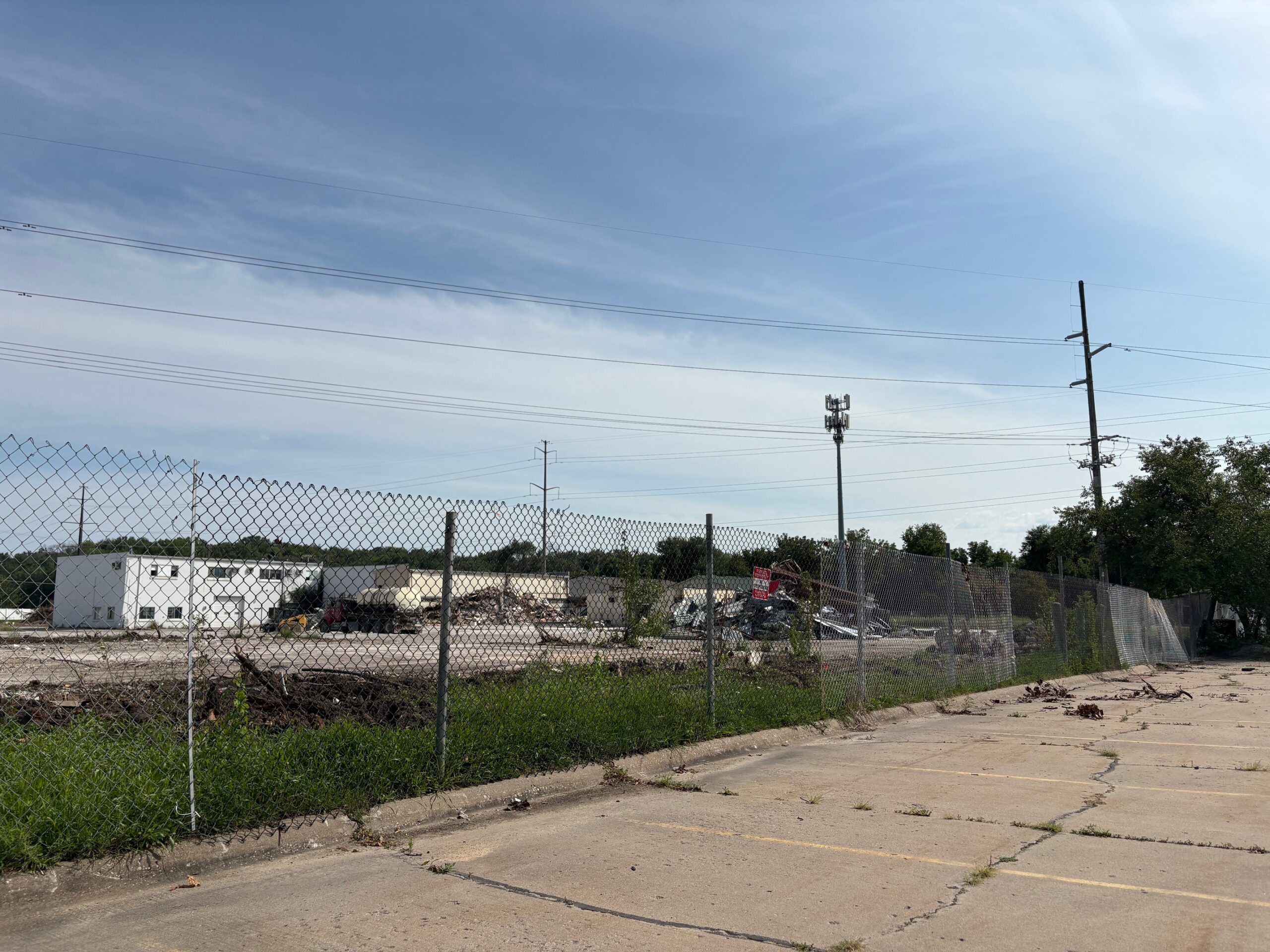
After successfully undergoing two rounds of plan approval in 2022 and 2023, Texas developer Rael Corp’s “Gather Iowa” project returned earlier this year with an altered site plan for redeveloping 10-acres at 1st Avenue and Highway 6 in southeast Coralville. After receiving city council approval for the site plan in January, demolition of the site’s many extant structures began just a few weeks ago.

The Specter
The city and local business groups have long sought changes in the project area. The 2014 Coralville Community Plan designated the site as the “Southeast Commercial Subarea” with its own masterplan produced in 2017, in addition to the Greater Iowa City, Inc (à la chamber of commerce) including the area within its “5th Street Strategic Investment District” as part of the group’s local economic development effort. Based upon comments at a January Planning and Zoning Commission hearing, both entities view the “highly visible” area as brimming with potential as a “gateway” for Coralville, but describe it as underutilized and in need of investment. The 2017 district plan pays tribute to the area’s longstanding immigrant community and businesses while imagining the site becoming an eclectic “International Village” with an ”Old World” feel and a regional attraction:
“The 17-acre site possesses rare and distinctive attributes in relation to location, prominence, and an international cultural heritage and presence…. The Master Plan design capitalizes on these unique opportunities proposing a mixed-use development supporting an eclectic mix of international restaurants, businesses, and ‘Village’ populace…. ” (City of Coralville & Brockway Land Planning Associates).
Not only is the plan amateurish (just look at its graphics!) and sparse of actionable details, the language regarding the diversity of the area community appears othering and exocitizing. When considered in the context of city staff and interest groups considering the site underutilized and underinvested for its “prime” location, the approach becomes exploitative and reminiscent of the legacy of blight clearance under urban renewal. The exclusion of the Walgreens and MidWestOne Bank parcels (despite their outmoded, auto-oriented design, and visibility) from the subarea within city plans is particularly indicative of this sentiment.

It is undeniable that the area was rife with issues: the now-demolished structures and pavement were in poor condition, flooding and pooling water were consistent concerns, while access and pedestrian safety were lacking. However, without serious subsidy, permanent displacement is inevitable– how would one reasonably expect the prior businesses to return for an “International Village” and risk reestablishing under new build, market-rate rents after several years of construction?
From the minutes of a January public hearing, “Greater Iowa City, Inc. has discussed potential relocation programs” for the impacted businesses. Notably, the voices of the site’s business-owners and residents appear largely missing in the public hearings and local reporting. Perhaps the local community is in support of redevelopment due to the site’s poor physical condition. The problem remains that this is not clear.
Such is too often a blind spot for pop-urbanism and NIMBY-YIMBY debates: the exploitative, destructive side of urban development is missed for the promotion of housing production above-all-else and aesthetic concerns of built-form. I share the desire for more attractive, urban cities. Redevelopment, improvements, and more housing supply are absolutely necessary for a more resilient and sustainable future. We must not forget to ask: who is shouldering the cost of these changes?
We must recognize that Coralville’s public plans and the private development processes have created conditions in which a national chain drugstore and a regional bank will avoid the costs of redevelopment, while locally-owned, immigrant businesses burden the uncertainties of relocation. This is a spectre that will hang over Gather Iowa– regardless of the project’s merits and weaknesses.
The Merits
As shown in the Planned Unit Development site plan, Rael Corp is seeking to redevelop the site with the following:
- A 295 unit midrise multifamily building with a large parking structure
- Two single-story commercial strips fronting 2nd Street
- A 34 unit affordable housing project
- Major re-engineering of infrastructure
- Two new signalized intersections at the site’s access points
Updated renderings and final building details will not be available until the final plat is submitted. Substantial completion is not expected until 2027, with the construction of a hotel planned for a future phase.

The merits of the project are found in its infrastructure upgrades, street network improvements, well-located housing density, and (somewhat) reduced parking.
The site’s low-lying location near Clear Creek places it firmly in FEMA’s Flood Hazard Areas and the poor pavement grading often resulted in large pools of water after rains. Rael Corp intends to work with Coralville to replace and regrade the site’s infrastructure and raise the new buildings to help mitigate any future risk of flood damage. The June 2008 flood still looms large in Coralville’s history, which inundated the subject area in several feet of water.
Beyond reconstructing the site’s two public streets for flood mitigation, 2nd Avenue will be relocated farther west, several curb cuts will be eliminated, and signalized intersections will be created at each street’s access point: one at 2nd Avenue and 2nd Street and another at 1st Street and 1st Avenue. The improved streets are greatly beneficial for site access and pedestrian safety. The reduction of curb cuts and a new light along 2nd Street is particularly significant, as this stretch frequently sees pedestrians attempting dangerous mid-block crossings of the heavy arterial street (stroad). The new signal will provide a closer, safer option for those needing to cross 2nd Street on foot.
With 329 dwelling units, the project will achieve a housing density of nearly 33 units per acre. The future residents will enjoy access to high-frequency bus service just 500 feet away. Traveling to the University of Iowa Hospital or downtown Iowa City from the site are easily achievable by foot, bike, or bus, making car-free or car-lite living possible.
The earlier iteration of Gather Iowa included more than 900 parking spaces. Fortunately, the current plan reduced the number of spaces to 730, which is below Coralville’s minimum parking standards. A limited victory, however, as this is still a significant quantity of parking for such a well connected location. It will exceed a ratio of one space per dwelling unit. Rael Corp is missing an opportunity to reduce parking to either add additional homes, or eliminate excessive surface pavement.
The (Other) Weaknesses
In addition to my concerns regarding displacement, I am critical of the plan’s lack of clarity regarding the affordable housing portion and Rael Corp’s connections to undesirable trends in the financialization and privatization of student housing– despite not presenting Gather Iowa as a student housing project.
During the public hearings for the current plan, neither the developer nor Greater Iowa City, Inc. have provided substantive details for the 34-unit affordable housing building leaving many questions: Will the units be funded through local, state, or federal subsidies? What does affordable mean and for who? For how long? Prior plans included market-rate townhome units in place of the affordable housing portion– which conveniently matches the exact number of units being lost to demolition. Generally, a precise number of units can only be determined once financing and the affordability characteristics are secured. It appears that there is an unacknowledged risk that the project could complete construction while the affordable portion languishes and sits empty for years. Cynically, if the plan is not solidified soon, it is easy to foresee the lot being developed into something else during the next phase of the project (once the sting of displacement has softened).
Equally lacking in the proposal for Gather Iowa are any mentions of student housing, despite Rael Corp specializing in purpose-built student housing projects. Its portfolio includes:
- Gather Illinois near the University of Illinois Urbana-Champaign
- Gather Bellingham near Western Washington University
- Gather Southern across the street from the University of Memphis
- Gather Oxford at Ole Miss. It’s really coming together (gathering?) now.
Once construction is complete, these projects are quickly sold off to institutional real-estate portfolios and their management firms with mixed results for residents. Rael Corp’s website even includes a status bar to show when its properties are sold.
In recent years, there has been growing awareness of the negative impacts of the boom in financialized student housing developments that began the 2010s. While these large projects often produce needed housing units with plentiful amenities, college students are paying more for their housing than before (as is everyone). A recent paper from the UC Berkeley Goldman School of Public Policy highlights that this trend has impacted housing affordability for students, outcompeted local producers, and decreased investment in on-campus housing:
“[T]he financialization of student housing has created a ‘crisis by design,’ transforming student housing from a basic need into a profit-driven asset class.” (Jiang-Brittan, 2025).
Why was Gather Iowa not presented as a purpose-built student housing project when other indicators suggest that it is intended as such? Perhaps, as with Iowa City avoiding student housing for 21 S Linn Street, there is growing local skepticism and fears of oversaturation. When considering the project’s likely high-capital institutional investors in contrast to the displaced local immigrant-owned businesses, the exploitation becomes more alarmingly apparent.
Again, housing density will be created in a well-located area with ample transit and the site’s infrastructure will receive vital improvements. Yet, we cannot let the exploitative forces of financialization and displacement go unexamined. We can and should strive for localized, incremental projects that serve the community holistically.
Before beginning full construction, the project must pass a final site plan review– let’s hope that the affordable housing portion will be funded and secured by then. Meanwhile, the specter looms.
Update (09/24/25): A final PUD plan for the Gather Iowa project was presented at Coralville’s September 23rd city council meeting. As echoed above, the affordable housing portion of the project has been sidetracked to the project’s future phase with no additional details of features or funding. Rael Corp says July 2027 is the expected completion date of the current project phase. If the affordable housing ever gets built, it is unlikely to benefit tenants until the 2030s– the units demolished for this site are effectively lost.
The updated site plan included renderings of the apartment complex and two commercial buildings. Check out the meeting agenda to view all renderings and the full plan.

TRANSPORTATION
CRANDIC Dead. Now what?
Last year, I covered the various options in contention for CRANDIC: Pop-Up Metro, Commuter Rail, and Bus Rapid Transit.
Read: What would Pop-Up Metro or BRT look like for Iowa City?
I concluded that an electrified commuter rail would be the best option for the route, as BRT would be better suited to a major road, such as US Highway 6. After years of studying the feasibility of mass transit along the Cedar Rapids and Iowa City Railroad (CRANDIC) right-of-way, the line’s owner informed Johnson County that it is no longer interested in hosting any projects (CBS 2 Iowa Report).
If commuter rail is off the table, it is clear: invest in local bus services. Higher frequency and wider network coverage is an imperative for getting people out of cars.
Invest in the buses.